On this page
This guide covers how AI sales coaching actually works, where it helps, where it doesn’t, and how to build it into a team’s daily routine — starting with the connected workflow we built AllAI Outbound around.
How AllAI Outbound Connects Coaching With Sales Work
At AllAI Suite, we have designed AllAI Outbound around a connected sales workflow.
The aim is not to create another coaching dashboard that sits separately from prospecting, outreach and CRM activity.
Depending on the customer’s requirements, AllAI Outbound can connect:
● Account and prospect research
● Personalised outreach
● Multi-step sequencing
● Customer conversations
● Coaching insights
● Manager review
● CRM actions
● Compliance checks
● Audit visibility
● Proposal and RFP support
This means a coaching insight does not need to end as a score inside a separate platform.
It can influence what the representative practises next, where the manager provides support and what action happens with the account.
AllAI Suite is positioned as one connected platform across business functions. Its Sales Suite includes AllAI Outbound and AllAI CRM, allowing organisations to connect outbound activity with pipeline and revenue workflows.
Disclosure: AllAI Outbound is built by AllAI Suite, the company publishing this article. It’s included here because the coaching model described in this guide is the one we built it around — weigh it against other platforms based on your own team’s requirements.
Why teams choose AllAI Outbound for coaching:
● One workflow for outreach, conversations, coaching and CRM activity, instead of four or five disconnected tools
● Coaching insights that feed back into practice, manager review and the next account action
● Configured around the customer’s own playbooks, scorecards and sales process, not a fixed template
● Built for teams without a dedicated RevOps, enablement or sales-ops hire to run it
See how AllAI Outbound can be configured around your sales and coaching process
A sales representative can complete onboarding, understand the product and memorise the approved pitch—and still struggle when a buyer raises an unexpected question.
The problem is not always a lack of training.
The real gap often appears between knowing what to say and being able to apply that knowledge during a live customer conversation.
A representative may understand the pricing model but fail to explain its value. They may know the discovery framework but move to the demo too quickly. They may have read the objection-handling playbook but become defensive when a buyer mentions a competitor.
Traditional sales coaching can help, but it depends heavily on manager availability.
A manager may review a few conversations each week. Meanwhile, the team may be running dozens of discovery calls, demonstrations, renewal conversations and prospect meetings every day.
That is where AI sales coaching becomes useful.
It gives representatives more opportunities to practise, receive timely feedback and improve specific behaviours. It also helps managers find the conversations that need attention without manually reviewing every call.
For companies comparing B2B sales enablement tools, the important question is not whether the platform includes AI.
The question is whether that AI helps representatives perform better during real customer conversations.
Quick Answer
AI sales coaching uses artificial intelligence to help sales representatives practise conversations, review performance and receive personalised guidance.
Depending on the platform, coaching can happen:
● Before a call through AI simulations and role plays
● During a call through live prompts and objection support
● After a call through conversation analysis and scorecards
● Between calls through on-demand practice and feedback
The strongest systems connect all four stages.
Instead of treating onboarding, customer conversations and manager coaching as separate activities, AI creates a continuous improvement loop around the representative’s daily work.
Salesforce describes AI sales coaching as personalised training and feedback that can support role plays, pitch practice, knowledge reviews and preparation for next steps.
Get a quick walkthrough of how AllAI Outbound coaches reps →
What Is AI Sales Coaching?
AI sales coaching is the use of artificial intelligence to analyse representative performance, simulate sales situations and provide personalised feedback.
It can evaluate how a representative:
● Opens a conversation
● Explains the product
● Asks discovery questions
● Responds to objections
● Discusses pricing
● Handles competitor comparisons
● Confirms next steps
● Follows the company’s sales process
The term AI Sales Coaching Software can describe several types of technology.
Some platforms focus on recorded-call analysis. Others specialise in AI role plays, live conversation assistance or manager coaching dashboards.
These capabilities are related, but they do not solve exactly the same problem.
A conversation-intelligence platform may help a manager understand what happened after a call.
An AI simulation platform may help the representative practise before a call.
A live assistant may provide relevant information while the representative is speaking with the buyer.
A complete coaching workflow connects these stages.
It first identifies what the representative needs to improve. It then provides relevant practice or guidance and measures whether the behaviour changes in future conversations.
See how AllAI Outbound turns coaching intoeveryday practice →
AI Coaching vs Traditional Coaching
Traditional coaching depends heavily on the manager’s time.
A manager listens to a call, writes notes, schedules a one-to-one session and explains what the representative could do differently.
That human input remains valuable. The challenge is delivering it consistently across a growing team.
Traditional coaching | AI-assisted coaching |
|---|---|
Usually based on a sample of calls | Can review a much larger share of conversations |
Feedback may arrive days later | Feedback can be available shortly after the call |
Practice depends on manager availability | Representatives can practise on demand |
Coaching may vary between managers | Shared scorecards can create greater consistency |
Skill gaps may be identified informally | Patterns can be tracked across conversations |
Managers search manually for coaching moments | AI can surface calls that require attention |
AI does not remove the need for a sales manager.
It reduces the time managers spend searching for coaching opportunities. Managers can then focus on judgement, confidence, motivation, deal strategy and complex situations where human experience matters most.
How AI Sales Coaching Works
The exact process varies between platforms, but most systems follow six stages.
1. Sales data is connected
The platform may use information from:
● Call recordings
● Meeting transcripts
● CRM records
● Email conversations
● Sales playbooks
● Product documentation
● Objection-handling guides
● Training content
● Previous coaching sessions
This information gives the AI context.
Without company-specific context, the platform may provide generic advice that sounds reasonable but does not match the organisation’s actual product, customer or sales motion.
2. Conversations are analysed
The system transcribes and examines customer conversations.
It may identify that:
● The representative spoke for too long
● Pricing was introduced too early
● A competitor was mentioned
● An objection was not explored
● The buyer asked an unanswered question
● No clear next step was agreed
● An important stakeholder was missing
Conversation-intelligence platforms use AI to identify topics, objections, interaction patterns and other signals from calls and meetings.
3. Performance is compared with a framework
The system needs a standard for evaluating the conversation.
This may include:
● A discovery-call framework
● A qualification methodology
● An approved product narrative
● A custom scorecard
● Successful behaviours from experienced representatives
● Compliance requirements
● Different expectations for each deal stage
The company must define what good performance looks like.
AI should support the sales methodology rather than invent one.
4. Feedback is generated
Useful feedback should explain:
● What happened
● Why it mattered
● What the representative could do differently
● Which playbook or resource may help
● What the representative should practise next
A low score alone does not improve performance.
The representative needs a specific action they can apply during the next conversation.
5. The representative practises
The system may generate a role play based on the identified gap.
For example, if a representative struggled with a pricing objection, the next simulation could involve:
● A cost-conscious buyer
● A procurement stakeholder
● A competitor comparison
● A request for a discount
● A buyer who does not understand the expected value
The representative can repeat the situation until the response becomes clearer and more confident.
6. Managers receive priorities
Managers do not need to review every interaction.
They can focus on:
● Representatives with recurring skill gaps
● Important deals with weak execution
● Objections appearing across several accounts
● Conversations where AI and manager judgement differ
● Strong examples that could help the rest of the team
This makes AI a coaching assistant rather than a replacement for sales leadership.
Turn customer conversations into practical coaching actions →
Key AI Coaching Capabilities
Feature lists can make every platform appear similar.
A better way to evaluate AI Sales coaching software capabilities is to examine what the system helps representatives do before, during and after customer conversations.
Call recording and transcription
The platform records calls or meetings and creates a searchable transcript.
This gives representatives and managers a reliable record of what was said instead of depending on memory or incomplete notes.
AI-generated summaries
The system identifies important discussion points, buyer priorities, objections, commitments and next steps.
Summaries can reduce administrative work, although representatives should still review important details before updating the CRM or contacting the buyer.
Automated call scoring
Calls can be evaluated against a company-defined rubric.
A discovery scorecard might measure whether the representative:
● Established an agenda
● Identified the buyer’s problem
● Explored the business impact
● Understood the decision process
● Confirmed the next action
Scores should guide coaching conversations. They should not be treated as a perfect measurement of sales ability.
Personalised coaching
The platform identifies which behaviour each representative should improve.
A new representative may need product knowledge and discovery practice.
An experienced representative may require support with negotiation, executive conversations or complex buying groups.
AI role plays
AI role plays allow representatives to practise with a simulated buyer.
Modern ai conversation simulation software can change the buyer’s role, personality, industry, objection and level of interest.
The representative can repeat the exercise without requiring a manager or colleague to play the buyer every time.
Mindtickle describes AI role play as a way for representatives to practise pitches, objections and realistic customer situations while receiving immediate feedback.
Live conversation guidance
Some platforms can identify questions, objections or competitor mentions during a call and present relevant information.
This may include:
● An approved objection response
● A product answer
● A relevant case study
● A discovery question
● A competitive differentiator
● A compliance reminder
Live guidance should be short and relevant. Too many prompts can distract the representative from listening to the buyer.
Objection analysis
AI can group objections across conversations.
Sales leaders can then understand whether buyers repeatedly raise concerns about:
● Price
● Timing
● Implementation
● Security
● Integration
● Internal resources
● Competitors
● Return on investment
These insights can improve coaching, positioning, content and product communication.
On-demand feedback
Representatives do not always need to wait for the next manager meeting.
They may be able to upload a pitch, complete a role play or review a recent conversation and receive feedback immediately.
This is particularly useful for new hires, distributed teams and representatives preparing for an important meeting.
Manager dashboards
A manager dashboard may show:
● Team-wide skill trends
● Individual development areas
● Common objections
● Coaching completion
● Conversations requiring review
● Recommended manager actions
● Examples from successful representatives
CRM integration
Coaching becomes more useful when it understands the account, opportunity and deal stage.
A first discovery call should not be evaluated in the same way as a final commercial negotiation.
CRM context helps the platform understand what the representative was trying to achieve.
Identify which coaching capabilities your team actually needs →
Coaching Before, During and After Calls
The most practical AI coaching model supports the representative throughout the complete conversation lifecycle.
Before the call
Before speaking with a buyer, AI can help a representative:
● Review the account
● Understand previous interactions
● Identify likely stakeholders
● Prepare discovery questions
● Practise the value proposition
● Simulate likely objections
● Review relevant product information
The practice becomes more valuable when it reflects the actual account.
For example:
You are meeting the operations director of a mid-market logistics company. The business already uses a competing platform, has limited implementation resources and is concerned about switching costs.
That simulation is more useful than a generic instruction to practise objection handling.
During the call
During the conversation, AI may provide real-time assistance.
A buyer might ask a technical question that the representative cannot answer from memory. Instead of searching through several documents or giving an uncertain response, the system can retrieve an approved answer from the company’s knowledge base.
Live coaching may also identify:
● Pricing objections
● Competitor mentions
● Buying signals
● Missing discovery questions
● Compliance-sensitive language
● Requests for particular content
● Unanswered questions
The objective is not to script every sentence.
It is to make relevant information available when the representative needs it.
After the call
After a conversation, AI can:
● Create a summary
● Identify objections
● Score selected behaviours
● Recommend a follow-up action
● Prepare CRM updates
● Highlight moments for manager review
● Create a relevant practice exercise
● Track whether the same issue appears again
A call score alone does not create improvement.
The representative needs to know what to change before the next conversation.
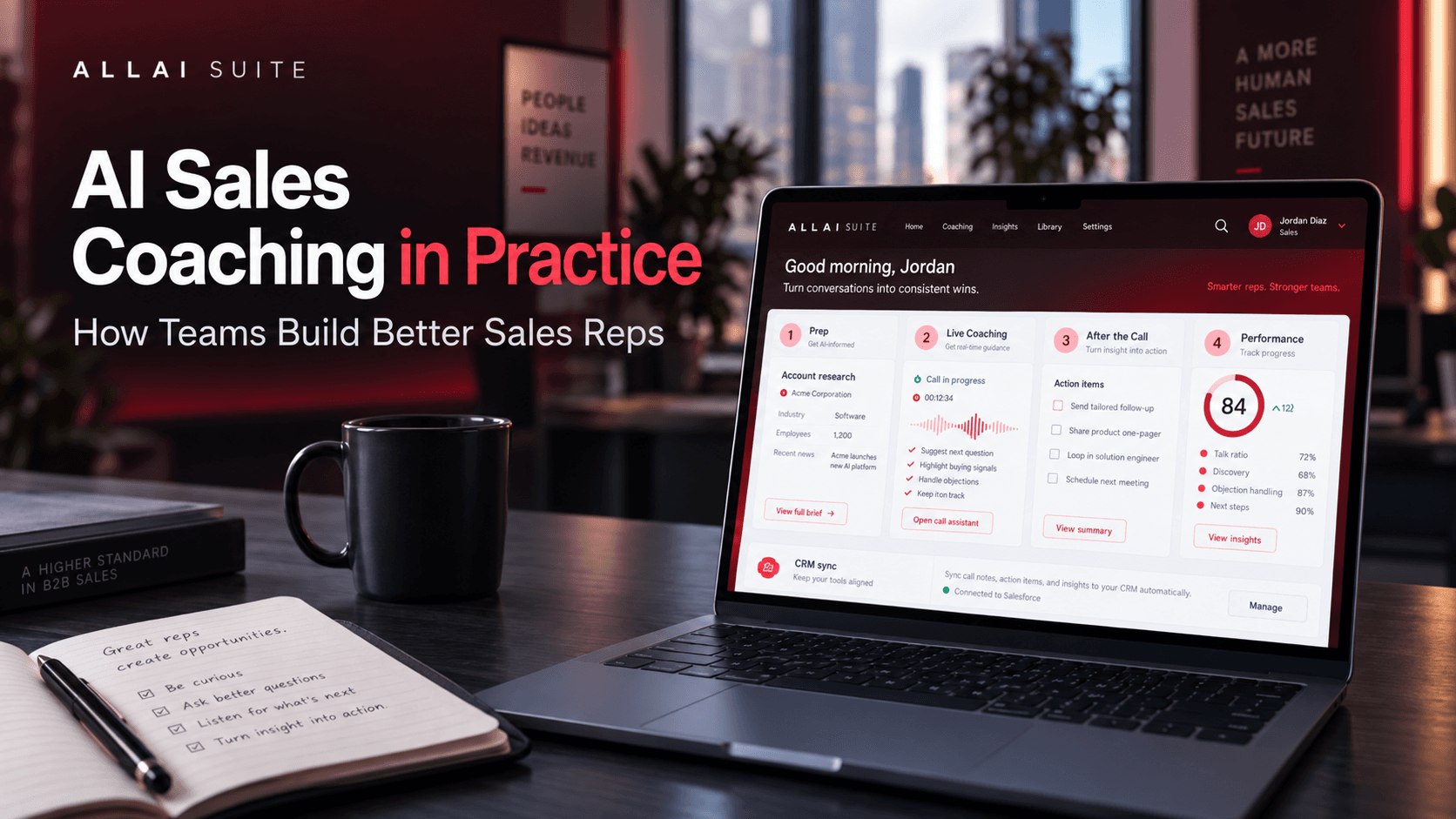
● Before the call: account research, buyer context and AI practice
● During the call: transcription, objection detection and approved guidance
● After the call: summary, scorecard, coaching recommendation and CRM action
Common Uses of AI Sales Coaching
AI coaching can support different stages of representative development.
New-representative onboarding
New hires often receive a large amount of information within a short period.
They need to learn:
● The product
● The target customer
● The sales process
● The CRM
● Qualification rules
● Competitor positioning
● Common objections
● The company’s messaging
AI coaching can turn that information into repeated practice.
Instead of completing a training module once, representatives can practise the same skill across several buyer situations.
The system may also help managers understand whether a new hire is ready for live customer conversations.
Discovery-call improvement
Representatives can sound confident while still running weak discovery calls.
They may ask a list of questions without properly exploring the buyer’s situation. They may move to the product too quickly or accept the first answer without understanding the business impact.
AI can identify patterns such as:
● Too many closed questions
● Limited follow-up questions
● Premature product pitching
● No discussion of business impact
● Missing stakeholders
● An unclear decision process
● No agreed next step
The manager can then coach one or two observable behaviours instead of giving broad advice such as “improve discovery.”
Product demonstrations
A strong demonstration connects product functionality with the buyer’s priorities.
AI can evaluate whether the representative:
● Confirmed what the buyer wanted to see
● Focused on relevant features
● Explained the business value
● Checked for understanding
● Responded clearly to questions
● Ended with an appropriate next step
Representatives can also practise demonstrations for buyers with different levels of technical knowledge.
Objection handling
Objection handling is one of the clearest applications of AI coaching.
A pricing objection could mean:
● The buyer does not understand the value
● The buyer has no approved budget
● A competitor is less expensive
● Procurement expects a discount
● The problem is not urgent
● The representative is speaking with the wrong stakeholder
Good coaching teaches the representative to understand the objection before trying to overcome it.
Negotiation
AI can simulate procurement or commercial discussions.
Representatives can practise:
● Protecting value
● Responding to discount requests
● Trading instead of conceding
● Confirming decision authority
● Handling implementation concerns
● Identifying when manager involvement is required
Other customer-facing teams
The use of ai sales coaching tools for customer conversations is not limited to account executives.
These tools may also support:
● Sales development representatives
● Business development teams
● Account managers
● Customer-success managers
● Renewal teams
● Partner managers
● Solutions consultants
● Contact-centre teams
Any role that depends on consistent customer conversations may benefit from structured practice and feedback.
See how AllAI Outbound supports coaching across SDR, AE, CS and renewal teams →
What Is On-Demand Coaching?
On-demand coaching allows a representative to request practice or feedback without waiting for a scheduled manager session.
The phrase ai sales coaching software on-demand coaching feedback can include:
● Practising a pitch with an AI buyer
● Uploading a recorded pitch for evaluation
● Reviewing feedback from a completed call
● Repeating an objection-handling exercise
● Asking for feedback on a discovery approach
● Preparing for a specific buyer meeting
● Reviewing product or industry knowledge
The main advantage is availability.
A representative preparing for an important call tomorrow does not need to wait until the next weekly one-to-one meeting. They can practise immediately and involve the manager when human guidance is required.
Private AI practice can also feel less intimidating.
Representatives may be more comfortable repeating a weak pitch with AI before presenting it to a manager or customer.
However, on-demand practice should not become isolated practice.
Managers still need visibility when the same problem appears repeatedly or affects important opportunities.
Try on-demand coaching inside AllAI Outbound →
What Managers Gain?
AI should help managers focus on the coaching moments that matter most.
The manager remains responsible for:
● Understanding the representative’s motivation
● Explaining broader deal context
● Coaching judgement
● Supporting complex negotiations
● Building confidence
● Correcting inaccurate AI feedback
● Deciding which behaviour matters most
AI is more useful for identifying patterns and organising practice.
For example, the system may show that a representative regularly responds to objections before asking a follow-up question.
The manager can then:
- Review two or three examples
- Explain why the behaviour limits the conversation
- Demonstrate a better approach
- Assign a targeted simulation
- Review whether the behaviour changes
This creates a coaching cycle based on observable behaviour rather than general impressions.
See how coaching insights show up in a manager's daily workflow →
Benefits for Sales Reps
The value of ai coaching software for sales reps depends on how well it fits the team’s daily work.
More practice
Representatives improve through repetition.
AI simulations allow them to repeat difficult situations without requiring another person to participate every time.
Faster feedback
Feedback is easier to apply when it arrives close to the behaviour.
Representatives can review the conversation while it is still fresh instead of waiting several days.
More relevant coaching
Different representatives have different needs.
AI can recommend practice based on an individual’s conversations rather than assigning the same training module to everyone.
Greater consistency
Shared scorecards help managers and enablement teams reinforce the same expectations.
This does not mean every representative should sound identical. It means the team can agree on the core behaviours required for a successful conversation.
Better use of manager time
Managers spend less time searching through recordings and more time discussing the moments that require experience and judgement.
A stronger link between training and execution
Many training programmes measure whether a representative completed a course.
AI coaching can help teams evaluate whether the representative later applied that learning during customer conversations.
Give your managers a coaching view that connects to the rest of the workflow →
Limits of AI Sales Coaching
AI coaching also has important limitations.
It cannot understand every relationship
A transcript may not capture the complete history, trust or internal politics surrounding an opportunity.
A response that appears weak in isolation may have been appropriate because of something discussed in an earlier meeting.
Feedback can be inaccurate
If the system uses incomplete information or an unsuitable scoring framework, it may assess a good conversation incorrectly.
Managers should regularly compare AI output with human reviews.
Too many prompts can distract reps
Sales conversations require active listening.
A representative who focuses too heavily on live prompts may pay less attention to the buyer.
It can feel like surveillance
Representatives may resist the platform when it is introduced mainly as a monitoring system.
Teams should explain:
● What will be recorded
● How the information will be used
● Who can access it
● Which decisions will remain human
● How incorrect feedback can be challenged
It does not replace human coaching
AI may identify a recurring behaviour.
A manager still needs to understand why it is happening. The representative may lack knowledge, confidence, preparation or belief in the company’s message.
Outreach similarly recommends treating AI feedback as an input to manager judgement rather than a complete replacement for it.
How to Start
Buying software is not the same as building a coaching system.
A practical implementation begins with the sales behaviour the company wants to improve.
1. Define the problem
Start with one clear problem, such as:
● New representatives take too long to become call-ready
● Discovery quality varies across the team
● Pricing objections are handled inconsistently
● Managers cannot review enough conversations
● Product messaging changes between representatives
● Customer calls end without clear next steps
Avoid starting with a broad goal such as “use more AI.”
2. Choose a few behaviours
Select two or three behaviours that can be observed.
For example:
● Ask at least one follow-up question after an objection
● Confirm the buyer’s business impact during discovery
● End qualified conversations with an agreed next step
A focused scorecard is usually easier to trust than one containing dozens of measurements.
3. Connect approved knowledge
Ground the system in:
● Current product information
● Approved messaging
● Qualification rules
● Objection frameworks
● Relevant case studies
● Security and compliance answers
● Company-specific sales processes
The quality of the coaching depends heavily on the quality of this information.
4. Run a small pilot
Begin with representatives and managers who are willing to provide detailed feedback.
During the pilot, check:
● Transcript accuracy
● Scoring quality
● Simulation realism
● Whether live prompts are distracting
● Whether representatives understand the feedback
● Whether recommendations lead to action
5. Compare AI and manager reviews
Managers should review a sample of calls and compare their assessments with the AI.
When they disagree, investigate why.
The scorecard may need to change, the system may lack context or the manager may be applying an expectation that has never been documented.
6. Present it as a development tool
Representatives need to understand how the system helps them.
A rollout focused only on monitoring and scores is likely to create resistance.
A rollout focused on preparation, practice and useful feedback is more likely to gain adoption.
7. Add it to existing routines
AI insights should appear in workflows the team already follows:
● Weekly one-to-one meetings
● Pipeline reviews
● New-hire onboarding
● Call-calibration sessions
● Deal-strategy discussions
● Monthly enablement programmes
Map AI coaching to your current sales process and systems →
How to Measure Results
Coaching should not be measured only by logins, completed simulations or generated scorecards.
Use three levels of measurement.
Adoption
These metrics show whether the team uses the process:
● Practice sessions completed
● Feedback reviewed
● Manager actions completed
● Calls available for analysis
● Representatives using the system
Behaviour
These metrics show whether the targeted skill is changing:
● Discovery-question quality
● Follow-up questions after objections
● Next-step confirmation
● Relevant value communication
● Use of approved messaging
● Improvement in selected scorecard areas
Business outcomes
These metrics show whether behavioural changes contribute to commercial results:
● Time to first qualified conversation
● New-hire ramp time
● Meeting-to-opportunity conversion
● Opportunity progression
● Sales-cycle length
● Win rate
● Customer retention
● Expansion revenue
The impact may not appear immediately.
A representative may improve objection handling before the change becomes visible in win rates. Teams should therefore track behavioural and commercial outcomes together.
See what connected coaching looks like for your reps →
How AllAI Outbound Connects the Process
Many sales teams already have training content, call recordings, outreach software and CRM data.
The problem is that they are often separated.
A representative may:
● Research an account in one platform
● Create outreach in another
● Record the call elsewhere
● Review feedback in a coaching tool
● Update the CRM manually
● Prepare the proposal in another system
Every handoff creates an opportunity for context to be lost.
AllAI Outbound is designed to connect these activities.
When a representative struggles with an implementation objection, the workflow can be configured to:
- Identify the relevant part of the conversation
- Compare the response with the approved playbook
- Explain what could be improved
- Recommend a targeted practice situation
- Alert the manager when human support is needed
- Record the relevant next action in the CRM
- Preserve the account context for future follow-up
This is also why AllAI Outbound is not positioned as one rigid setup for every organisation.
The solution can be customised around the customer’s:
● ICP
● Products and services
● Sales motion
● Qualification process
● Buyer roles
● Objection frameworks
● CRM structure
● Existing tools
● Coaching process
● Compliance requirements
AllAI Suite also maintains a demo-video library featuring product tours, CRM connection tutorials, sequence-building guidance and a full AllAI Outbound tour.
Book a tailored demonstration based on your team’s workflow →
How to Choose a Platform
Before selecting a platform, map the exact workflow it needs to improve.
Which coaching stage does it support?
Determine whether the team needs:
● Pre-call practice
● Live conversation assistance
● Post-call analysis
● Manager dashboards
● On-demand coaching
● A combination of these capabilities
Can it use your framework?
The system should allow the organisation to define what good performance looks like.
Generic scoring may not reflect the product, customer or methodology.
Are the simulations realistic?
Check whether the AI can reflect:
● Different buyer roles
● Industry context
● Deal stages
● Customer personalities
● Product-specific objections
● Different levels of difficulty
Is feedback grounded in approved information?
Understand whether recommendations come from company-approved content or are generated from a general AI model.
Can managers correct the AI?
Managers should be able to challenge scores, update frameworks and provide missing context.
Does it fit the existing workflow?
Review connections with:
● CRM
● Calendar
● Video-meeting software
● Dialler
● Sales-engagement platform
● Knowledge base
● Learning-management system
● Reporting tools
How is data handled?
Review recording consent, retention rules, access controls, model-training policies and regional privacy requirements.
Can it show improvement?
Useful reporting should connect coaching activity with changes in representative behaviour and sales performance.
The best platform is not necessarily the one with the longest feature list.
It is the one that creates a repeatable connection between conversation data, representative practice, manager coaching and the next sales action.
Compare AllAI Outbound against the platforms your team is evaluating →
Build Better Reps, Not Another Dashboard
AI sales coaching is most useful when it becomes part of how representatives work.
Before a conversation, it should help them prepare and practise.
During a conversation, it should make relevant information easier to access without distracting them from the buyer.
After a conversation, it should turn what happened into specific feedback and targeted practice.
Managers should then use those insights to decide where human coaching will have the greatest effect.
That is the difference between adding another sales tool and building a continuous representative-development system.
When comparing B2B sales enablement tools, begin with the conversation and behaviour the team needs to improve.
Then determine where AI can provide repetition, context and timely feedback—and where a manager still needs to lead.
AllAI Outbound is designed to connect prospecting, personalised outreach, customer conversations, coaching, CRM activity and compliance around the organisation’s existing sales process.
Because every sales team works differently, the solution can be configured according to customer requirements rather than delivered as a fixed coaching package.
Frequently asked questions
What is AI Sales Coaching Software?
AI Sales Coaching Software uses artificial intelligence to help representatives practise sales conversations, analyse completed calls and receive personalised feedback.
Depending on the platform, it may provide AI role plays, live prompts, automated scorecards, conversation analysis, coaching recommendations and manager dashboards.
What are the main AI Sales coaching software capabilities?
The main AI Sales coaching software capabilities include conversation transcription, AI role plays, call scoring, personalised feedback, objection detection, live knowledge retrieval, manager dashboards and CRM integration.
The right combination depends on whether the team needs help before, during or after customer conversations.
What does ai sales coaching software capabilities include?
The phrase ai sales coaching software capabilities may cover simulated conversations, on-demand practice, call analysis, objection detection, automated scoring, manager insights and workflow integrations.
Not every platform provides all of these features.
What is ai sales coaching software on-demand coaching feedback?
ai sales coaching software on-demand coaching feedback allows representatives to practise or request guidance without waiting for a scheduled session with a manager.
A representative may complete a role play, upload a pitch, review a call or practise a particular objection whenever support is needed.
How do ai sales coaching tools with real-time objection handling feedback work?
ai sales coaching tools with real-time objection handling feedback analyse a live conversation, identify a potential buyer concern and present a relevant prompt or approved resource.
The representative must still listen, ask follow-up questions and decide how to respond.
Are ai sales coaching tools for customer conversations limited to sales calls?
No. ai sales coaching tools for customer conversations may support account management, customer success, renewals, partnerships and contact-centre teams.
They can be used wherever conversation quality affects a customer relationship or commercial outcome.
What is ai conversation simulation software?
ai conversation simulation software creates interactive practice conversations between a representative and an AI-generated buyer.
It allows representatives to practise discovery, demonstrations, objection handling, negotiation and other skills in a controlled environment.
Who should use ai coaching software for sales reps?
ai coaching software for sales reps is useful for organisations with frequent customer conversations, several representatives, limited manager coaching time or a need for more consistent sales execution.
It can also help smaller teams create structured onboarding and repeatable practice.
How is AI sales coaching different from B2B sales enablement tools?
B2B sales enablement tools cover a wider range of functions, including training, onboarding, content management, playbooks, buyer engagement and analytics.
AI sales coaching focuses more specifically on developing representative skills and improving customer conversations.
Some enablement platforms include AI coaching as one component of a broader product.
Can AI replace a sales manager?
No.
AI can analyse conversations, identify patterns and recommend coaching actions. It cannot fully replace the judgement, empathy, motivation and experience of a capable sales manager.
The strongest model uses AI to make human coaching more focused and scalable.
About the author:
Shalmali Chanda Choudhury
Business Development Manager
With a background in business development and marketing, Shalmali Chanda Choudhury works across outreach, prospect research, campaign execution, and pipeline development at AllAI Suite. Her experience with customer conversations and market trends gives her a practical perspective on how AI is changing sales and marketing.